

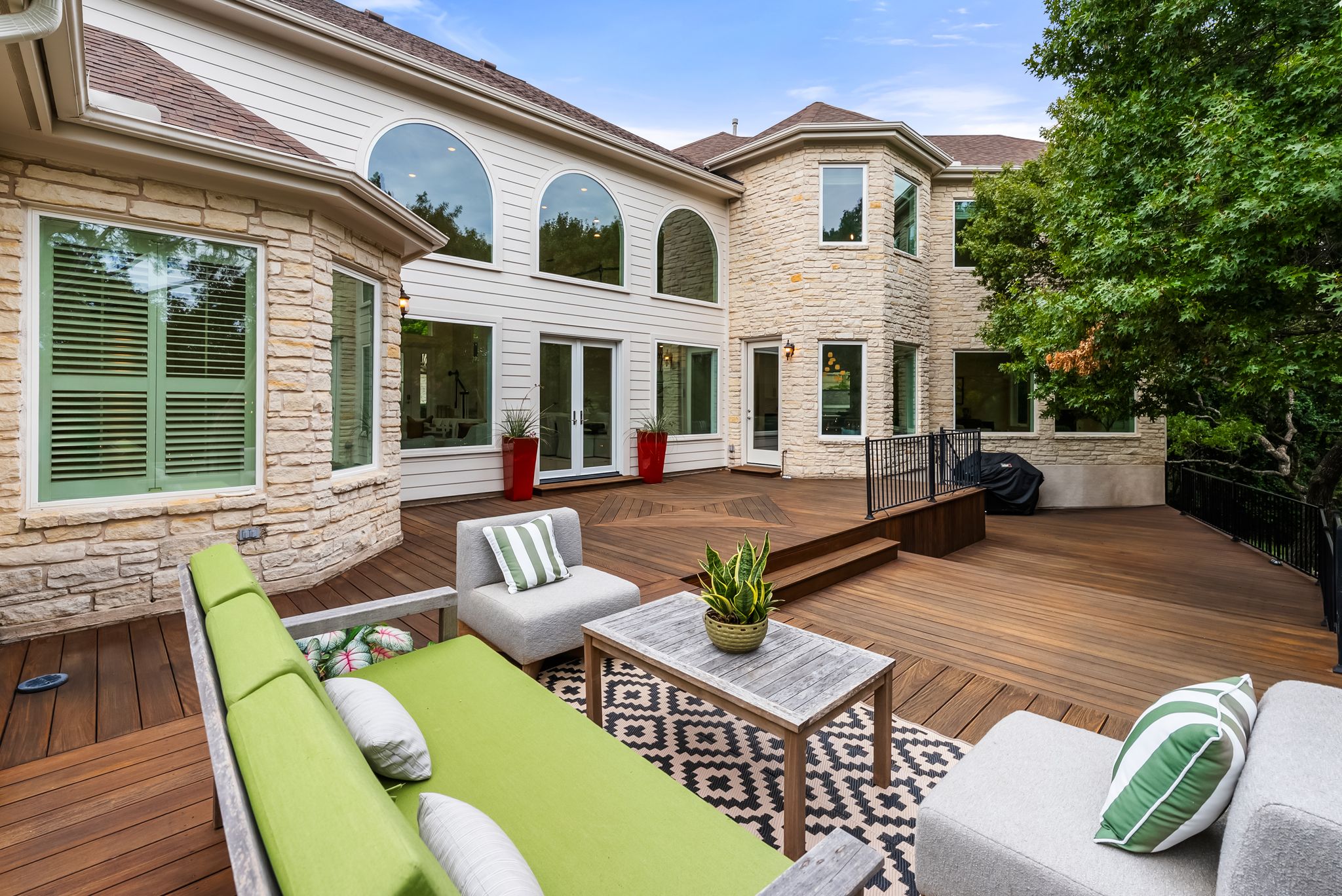
At a Glance
Retaining walls are common on Northwest Hills properties because of the neighborhood’s slopes and elevation changes.
A well-built, properly maintained retaining wall can make a difficult lot more usable and protect valuable outdoor space.
A cracked, leaning, poorly drained, or undocumented wall can become a significant liability and reduce buyer confidence.
Retaining walls should be evaluated together with drainage, grading, foundation conditions, and the overall usability of the lot.
Buyers should focus less on whether a property has retaining walls and more on why they are there, what condition they are in, and what they are holding back.
Northwest Hills is a neighborhood where the land itself is part of the property.
The hills, elevation changes, mature trees, canyon views, and unusual lot shapes are a big part of what makes the area desirable. But those same characteristics can create challenges that buyers don't encounter as often on flatter properties.
Retaining walls are one of them.
A retaining wall may simply be part of a beautifully landscaped backyard, creating terraces and usable outdoor space. Or it may be holding back a substantial slope and playing an important structural and drainage role.
That distinction matters.
In Northwest Hills, a retaining wall doesn't automatically hurt property value. In fact, a good retaining wall can increase the usefulness of a lot. But a wall showing signs of failure can create uncertainty, and uncertainty tends to get expensive quickly.
Why Are Retaining Walls So Common in Northwest Hills?
Northwest Hills sits in an area where elevation changes are part of the landscape. Many homes were built on sloping, tree-covered lots, and some properties were designed around the terrain rather than trying to eliminate it.
That means you will find homes with:
Terraced backyards
Steep slopes
Elevated homes
Split-level designs
Hillside driveways
Tiered landscaping
Decks and patios built into slopes
Retaining walls supporting portions of the property
Local Northwest Hills guides consistently identify slope, drainage, retaining walls, and foundation conditions as important considerations when evaluating hillside properties.
And there's an important distinction here:
A retaining wall isn't necessarily a problem.
Sometimes the wall is the thing that makes the property work.
Without it, the backyard might be too steep for a lawn, patio, pool, garden, or other outdoor use.
So the question isn't simply, "Does this house have retaining walls?"
The better question is:
"What is this retaining wall doing?"
Can a Good Retaining Wall Actually Increase Property Value?
Yes.
A properly designed and maintained retaining wall can make a sloped lot significantly more functional.
Imagine two properties with similar square footage and similar views.
One has a backyard that drops sharply away from the house.
The other uses terracing and retaining walls to create several usable areas for a patio, lawn, landscaping, or pool.
The second property may be much more appealing to buyers because the land can actually be used.
This is one reason lot usability matters so much in Northwest Hills. Buyers aren't necessarily paying for every square foot of dirt. They're paying for what the land allows them to do.
A retaining wall can help create:
Usable backyard space
Level areas for entertaining
Garden areas
Outdoor living spaces
Pool or patio opportunities
Safer transitions between elevations
Better landscaping options
In other words, the wall can turn a challenging slope into a functional part of the property.
That can have real value.
When Does a Retaining Wall Become a Liability?
The problem starts when the retaining wall itself becomes uncertain.
A wall that is leaning, cracking, bowing, deteriorating, or showing evidence of drainage problems can make buyers wonder what else is happening beneath the surface.
That concern is especially important on hillside properties because water and soil movement are interconnected.
Some warning signs include:
Noticeable leaning
Bulging sections
Significant cracking
Soil pushing through or around the wall
Erosion
Standing water
Poor drainage
Displaced landscaping materials
Failed or deteriorated materials
Evidence of previous repairs
Water collecting behind or near the wall
A buyer may see a $10,000 landscaping problem.
A structural professional may see something much more complicated.
That's why retaining walls should not be evaluated purely from a cosmetic standpoint.
How Does Drainage Affect Retaining Wall Value?
This is probably the most important part of the discussion.
Water is often the real issue behind retaining wall problems.
A retaining wall is holding soil back. When water builds up behind that soil, it can create substantial pressure against the wall.
That's why drainage is such an important component of a properly functioning retaining system.
On a Northwest Hills property, you want to understand where rainwater comes from, where it travels, and where it ultimately exits the property.
Look at:
Gutters and downspouts
Surface drainage
Grading
Drainage channels
French drains
Weep holes
Drainage outlets
Erosion
Water pooling
Areas where runoff reaches the wall
A retaining wall without an effective drainage strategy can become a much bigger concern than the wall itself.
Local guidance for Northwest Hills specifically recommends investigating drainage patterns and retaining-wall condition on sloped properties.
This is why I don't look at a retaining wall in isolation.
I look at the wall, the slope, the drainage, and the foundation as one system.
Does the Size of a Retaining Wall Matter?
Absolutely.
A small landscape wall is very different from a large wall supporting a major portion of a hillside.
The taller and more substantial the wall, the more important its construction, drainage, engineering, and condition become.
A buyer should pay particular attention when there are:
Tall retaining walls
Multiple tiers of walls
Walls supporting driveways
Walls near the house
Walls supporting major portions of a backyard
Walls close to property lines
Walls associated with significant grading
The bigger the role the wall plays in the property, the more important it becomes to understand how it was constructed and whether it has been properly maintained.
Can Retaining Walls Affect the Resale Value of a Northwest Hills Home?
They can, but there isn't a simple dollar amount you can assign to a retaining wall.
A good wall may contribute to value because it creates usable land.
A questionable wall may reduce value because buyers see future cost and uncertainty.
That's an important distinction.
The market doesn't necessarily say:
"This house has a retaining wall, so subtract $X."
Instead, buyers tend to think:
"What am I potentially taking on here?"
If the wall is in good condition and the property has documentation showing that previous work was done properly, the wall may barely be an issue.
If the wall is visibly failing and nobody knows when or how it was built, buyers may become much more cautious.
That can shrink the buyer pool.
And when fewer buyers are comfortable with a property, negotiating leverage tends to shift.
Does an Older Retaining Wall Automatically Mean Trouble?
No.
This is another area where buyers can get overly focused on age.
An older retaining wall isn't automatically a bad retaining wall.
Some walls have been doing their job for decades.
The better questions are:
Is it stable?
Is it properly draining?
Is there visible movement?
Is the surrounding soil stable?
Has it been repaired?
Has drainage changed?
Does it support anything important?
Is there documentation?
Has a professional evaluated it when necessary?
A wall that has been stable for decades may be less concerning than a newer wall that is already showing movement.
Age gives you context.
Condition tells you more.
What Should Buyers Ask About Retaining Walls?
If you're buying a Northwest Hills home with retaining walls, I would want answers to several questions.
What is the wall actually supporting?
Is it simply landscaping?
Or is it holding back a hillside, driveway, foundation area, or major portion of the backyard?
How old is it?
You may not get an exact answer, especially on older Northwest Hills properties, but any available history is useful.
Has it ever been repaired?
Ask what was repaired and why.
A repair isn't necessarily a negative. In fact, documented maintenance can be reassuring.
How does water drain behind it?
This is one of the most important questions.
Are there visible signs of movement?
Look for leaning, bowing, cracks, displaced materials, and erosion.
Is there documentation?
If the wall was part of a larger renovation or site improvement, ask for whatever plans, permits, engineering documents, invoices, or contractor information are available.
A lack of paperwork doesn't automatically mean something is wrong, particularly with older properties. But it can create additional uncertainty during due diligence.
Should a Buyer Hire an Engineer?
Sometimes the answer is absolutely yes.
A general home inspector can identify visible concerns, but a retaining wall can be a specialized structural issue.
If a wall is large, leaning, cracked, supporting significant soil, associated with drainage problems, or located near a foundation, driveway, or other important structure, it may warrant evaluation by an appropriate structural or geotechnical professional.
The goal isn't to turn every Northwest Hills purchase into an engineering project.
It's to spend the money when the physical characteristics of the property justify it.
That's a much better approach than ignoring an obvious concern because the house has a beautiful kitchen.
How Should Sellers Think About Retaining Walls?
Sellers should understand that buyers are likely to notice significant retaining walls, especially on hillside properties.
If you know a wall has been repaired, gather the documentation before putting the property on the market.
If there are drainage improvements, keep records.
If you've had an engineer evaluate the property, preserve the report.
And if there is an obvious problem, don't assume buyers won't notice.
They will.
In some cases, addressing a known issue before listing can make the property easier to explain and give buyers greater confidence.
In other cases, it may make more sense to sell the property as-is and price it accordingly.
The right decision depends on the condition of the wall, the cost of repair, the overall property value, and what comparable homes are doing.
Does a Retaining Wall Make a Northwest Hills Property Less Desirable?
Not necessarily.
This is where context matters.
A hillside property with retaining walls may have something a flat property can't offer:
elevation.
That could mean:
Better views
Greater privacy
More interesting architecture
Mature trees
Terraced outdoor spaces
Strong indoor-outdoor connections
Northwest Hills buyers already understand that hills are part of the neighborhood's character. Current local market guides note that view properties and elevated lots can command premiums, while the associated slope, drainage, and retaining-wall considerations need to be evaluated carefully.
So the presence of a retaining wall isn't the issue.
The question is whether the benefit of the lot outweighs the cost and complexity of maintaining it.
What Is the Biggest Mistake Buyers Make With Retaining Walls?
The biggest mistake is treating the wall as landscaping.
It isn't always landscaping.
Sometimes it is a critical part of the property's site engineering.
A beautiful stone wall can look completely harmless during a five-minute showing. But if it is holding back a significant slope and water is accumulating behind it, its condition suddenly becomes much more important.
The second mistake is looking only at the wall.
Walk uphill.
Walk downhill.
Look at the drainage.
Look at the foundation.
Look at the driveway.
Look at the neighboring properties.
Look at where rainwater appears to travel.
You're trying to understand the entire site, not just one piece of masonry.
How Should Buyers Factor Retaining Walls Into an Offer?
Don't automatically subtract a large amount from the offer just because a retaining wall exists.
Instead, determine:
What the wall does.
Its apparent condition.
Whether drainage is working properly.
Whether there are signs of movement.
Whether repairs have been made.
Whether documentation exists.
Whether professional evaluation is warranted.
What comparable properties with similar lots have sold for.
Then consider the risk-adjusted value of the property.
A house with an exceptional view and a well-maintained retaining system may be worth considerably more than a flat property with fewer lifestyle advantages.
But a beautiful view doesn't make an unstable wall disappear.
That's the balancing act.
The Bottom Line on Retaining Walls and Northwest Hills Property Value
Retaining walls can be either an asset or a liability.
A well-maintained wall can create usable space, protect a hillside, improve outdoor living, and make a challenging lot significantly more functional.
A failing or poorly drained wall can introduce repair costs, drainage concerns, structural questions, and buyer hesitation.
That's why I wouldn't assign a value adjustment simply because a property has retaining walls.
I'd evaluate the entire lot.
Look at the slope.
Look at the drainage.
Look at the foundation.
Look at the usable yard.
Look at the views.
Look at the privacy.
And then ask whether the retaining walls are helping the property realize its potential—or simply holding together a problem.
That's the difference between looking at a Northwest Hills home as a house and understanding it as a piece of land with a house on it.
#NorthwestHills #JamesLucas
Check out this article next