

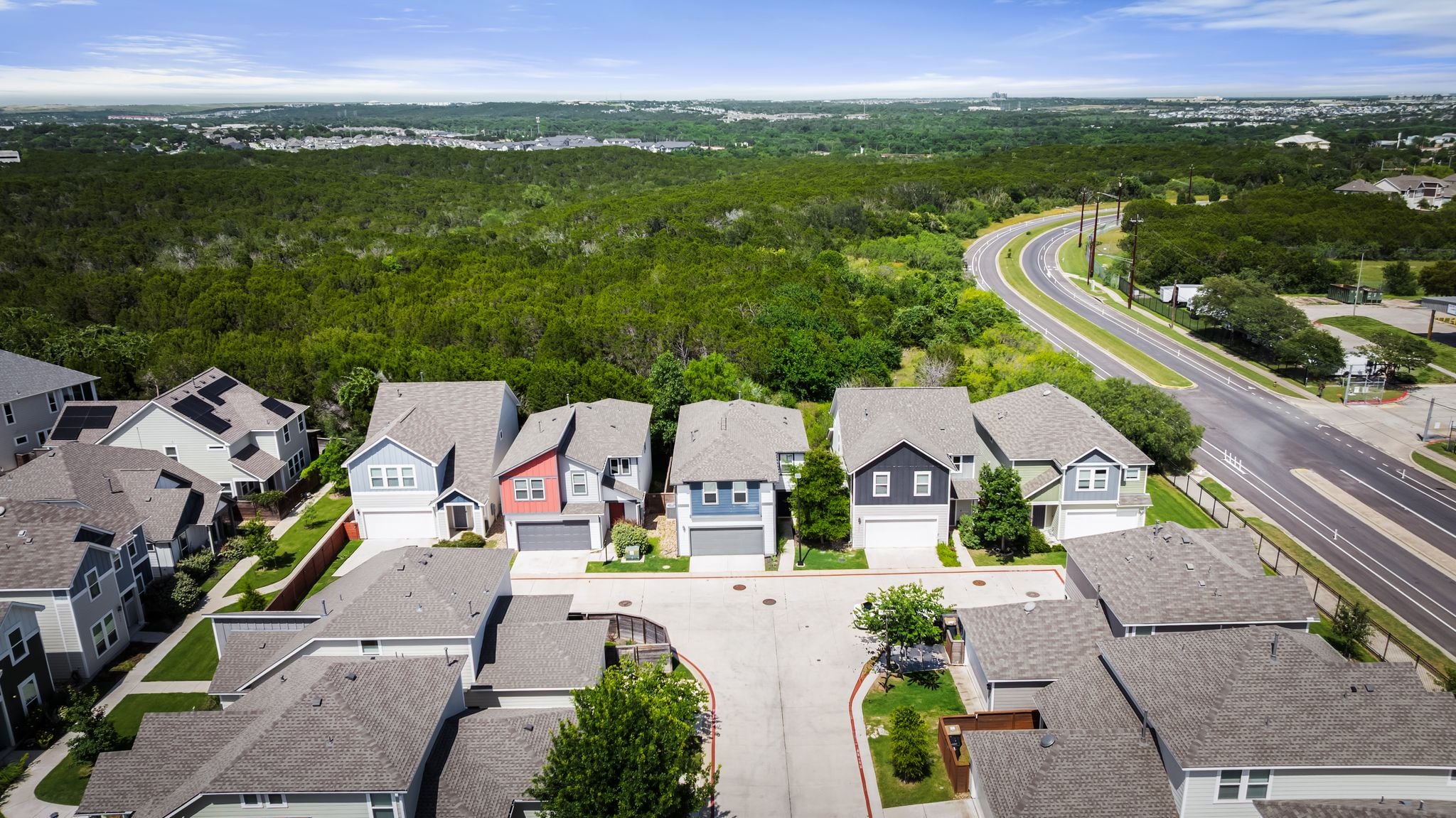
At a Glance
Northwest Hills offers rare central Austin access with a quiet, residential hill-country feel
Homes are older but often larger, with mature trees and established streets
Strong school zones and long-term demand keep the neighborhood consistently competitive
Property taxes and renovation needs are the most common “surprise costs” for buyers
Lifestyle is calm, stable, and residential—not urban or walkable in the modern sense
Northwest Hills doesn’t try to win every category.
And that’s kind of the point.
It’s not the newest.
It’s not the loudest.
It’s not the most walkable.
But it has something a lot of newer Austin neighborhoods are still trying to build:
A finished feeling.
Like the neighborhood already decided what it wants to be.
That comes with real advantages—and a few tradeoffs you should understand before you move.
The pros of living in Northwest Hills Austin
1. Central location without central chaos
One of the biggest advantages is geography.
Northwest Hills sits in a rare pocket of Austin where you can reach:
Downtown Austin in ~20–30 minutes
The Domain in ~10–20 minutes
Major highways like MoPac and 183 within minutes
It’s close enough to stay connected—but far enough that your street doesn’t feel like a shortcut for the whole city.
That balance is getting harder to find in Austin.
2. Mature trees and real neighborhood character
This is the visual identity of Northwest Hills.
Not planted-last-year landscaping.
Not uniform builder rows.
Actual decades-old oak canopy, curved streets, and lots that were designed before density became the norm.
It changes how the neighborhood feels day to day:
More shade
More privacy
Less visual sameness
A slower, more established rhythm
You don’t really “build” this anymore. You inherit it.
3. Strong school access drives long-term demand
A major driver of family demand is Austin ISD zoning, including schools like Doss Elementary, Murchison Middle, and Anderson High (depending on exact location).
Even buyers without kids pay attention to this.
Why?
Because school zones and resale demand tend to move together over time.
Northwest Hills has held that pattern for decades.
4. Bigger lots than most newer Austin neighborhoods
Compared to newer master-planned communities, Northwest Hills often offers:
Larger yards
More separation between homes
Flexible floor plans
Renovation potential instead of teardown dependency
It’s one of the reasons the neighborhood attracts move-up buyers instead of just first-time buyers.
Space still matters here.
5. A stable, “already established” neighborhood feel
There’s a reason people stay here a long time.
Northwest Hills isn’t in a constant state of reinvention.
It’s consistent:
Long-term residents
Predictable street patterns
Mature infrastructure
Less construction churn than outer Austin
It feels settled.
Not stagnant—settled.
There’s a difference.
The cons of living in Northwest Hills Austin
1. Older homes = uneven condition
This is the most common reality check.
Northwest Hills homes were largely built between the 1950s and 1980s.
That creates a wide gap:
Fully renovated modern interiors
Partially updated homes
Original-condition properties needing work
Two homes on the same street can feel like different eras entirely.
Buyers who don’t factor renovation costs upfront often feel this later.
2. Property taxes are a real monthly line item
Texas has no state income tax, but property taxes carry more weight.
In Northwest Hills, taxes can significantly affect monthly affordability depending on:
Purchase price
Appraised value
Homestead exemptions
School district rates
It’s not “cheap or expensive” in isolation.
It’s about total monthly ownership cost.
And that surprises people coming from lower-tax states.
3. Not a highly walkable daily-living neighborhood
This one depends on expectations.
You can walk in certain pockets.
But Northwest Hills is still largely:
Car-dependent for errands
Spread out across winding streets
Built around driving, not walking loops
You’re not living in a downtown-style lifestyle grid here.
You’re living in a residential hillside network.
4. Limited new construction inventory
If you want:
Brand new builds
Modern master-planned amenities
Uniform HOA-driven communities
This isn’t that neighborhood.
Most new activity comes from:
Renovations
Teardowns in select pockets
Infill projects
Supply is naturally limited, which also keeps competition steady.
5. Price pressure from long-term demand
Northwest Hills tends to hold value well—but that also means:
Less “discount buying” opportunity
Competitive listings in desirable zones
Faster decision timelines in hot segments
It’s not a hidden-gem pricing market.
It’s a known, established one.
That changes how you need to approach it.
What surprises buyers most in 2026
A few patterns show up again and again:
“It feels quieter than I expected”
Even for Austin, it has a noticeably residential tone during weekdays.
“The trees change everything”
Shade and canopy aren’t aesthetic here—they’re functional.
“Homes vary more than I thought”
Condition differences matter as much as location.
“It’s closer to everything than it feels on a map”
The geography compresses daily life in a good way.
Who Northwest Hills is a great fit for
This neighborhood tends to work best for:
Families prioritizing schools and stability
Professionals who want central access without downtown intensity
Buyers who value larger lots and mature neighborhoods
People planning long-term stays, not short flips
Who may want to think twice
It may not be ideal for:
Buyers wanting ultra-modern new construction everywhere
People prioritizing walkable nightlife districts
Buyers trying to minimize property tax exposure
Those who want uniform master-planned amenities
Questions buyers ask most often
Is Northwest Hills a good place to live in 2026?
Yes. It remains one of Austin’s most stable and established residential neighborhoods with strong long-term demand.
Are homes in Northwest Hills outdated?
Some are, some aren’t. The range is wide—renovation level matters more than age alone.
Is it worth the property taxes?
That depends on your budget and priorities. Many buyers accept higher taxes in exchange for location and lot size.
Is it family-friendly?
Very. Schools, parks, and long-term residential stability are major drivers of family demand.
Does it feel like “old Austin”?
In many ways, yes. Especially compared to newer suburban developments.
Final thoughts
Northwest Hills isn’t trying to be the newest version of Austin.
It’s already something else.
A neighborhood with roots instead of rollout plans.
With shade instead of glass towers.
With streets that curve instead of grids that scale.
The tradeoff is real:
you give up some modern convenience, some uniformity, and some walkability.
But what you get instead is harder to recreate:
A place that already feels lived in.
Already feels grounded.
Already feels like it’s going to be here for a long time.
And for a lot of buyers in 2026, that’s the part that wins.
#NWHills
Check out this article next